What is p53?
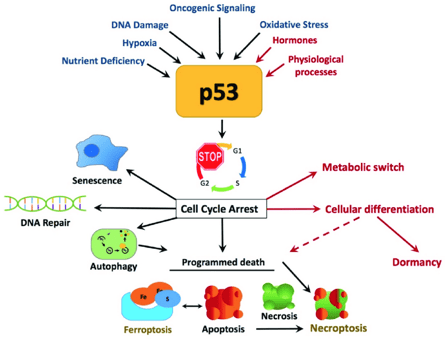
P53, also known as tp53, is a tumor suppressor gene like retinoblastoma (Rb). P53 suppresses tumor growth by regulating cell cycle. Most tumors have a p53 mutation, so a defect in p53 will lead to abnormal cell proliferation because there is no signal to kill the abnormal cells. P53 is also called the guardian gene because of its function. P53 was first identified in 1979 by Arnold Levine, David lane, and William old. It was first believed that p53 was an oncogene, but in 1989, it was revealed that it is a tumor suppressor instead. The p53 gene is located on the 17th chromosome, while the p53 protein has 393 amino acids and four domains: •Activates transcription factors •Recognizes specific DNA sequences •Recognizes damaged DNA Responsible for tetramerization of the protein.
p53 Regulation
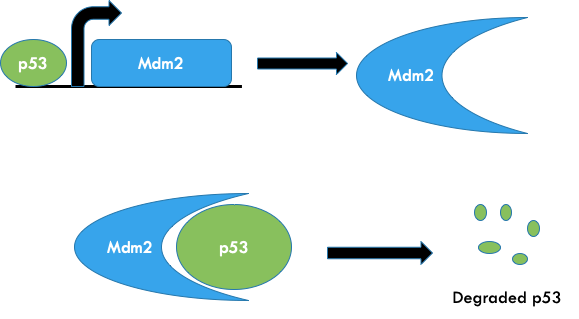
p53 is regulated by Mdm2, but Mdm2 is regulated by p53. Therefore, p53 regulates its own expression. p53 protein acts as transcription factor to turn on the expression on the Mdm2 gene, producing Mdm2 protein. Mdm2, via a ubiquitin system, binds to unphosphorylated p53 protein to degrade it. This is especially necessary in high amounts of p53 to prevent unnecessary cell death. If p53 is phosphorylated, Mdm2 cannot bind, therefore, no Mdm2/p53 complex is formed and p53 is not degraded.
Cell Cycle Regulation
The cell cycle is composed of several phases: G1 phase, S phase, G2 phase, and M phase. The cell has 2 checkpoints in its cycle. The 1st checkpoint is in G1 before synthesis, and in G2 before mitosis. These checkpoints are mediated by p53. When present, p53 will bind to the genome increasing the expression of p21. p21 is a protein that blocks cyclin/CDK. Cyclin/CDK is responsible for phosphorylating Rb in order to allow E2F to activate the S phase of the cell cycle. Therefore, more p53 leads to more p21, and less or no DNA synthesis. Additionally, p53 can increase expression of GADD45. GADD45 will inhibit Cdc2 which, and therefore stop M phase. Cdc2 expression is increased when cells pass the synthesis phase, but before they continue to mitosis, p53 checks the cells at G2 to make sure there is no DNA damage.
Apoptosis
When there is DNA damage, p53 can signal the cell to die in a process called apoptosis. Apoptosis is programmed cell death. It is important because it controls cell growth and kills cells that may be abnormal or infected. p53 activates expression of Bax and Apaf1. Bax activates Cytochrome C that binds to Caspase 9. Cytochrome C also promotes Apaf1 binding to Caspase 9, and the formation of the Cytochrome C/Caspase 9/ Apaf1 complex induces cell apoptosis.

References
•https://www.researchgate.net/figure/p53-canonical-and-non-canonical-tumor-suppressor-roles-of-p53-p53-is-activated-by-a_fig1_325657277 •http://www.bioinformatics.org/p53/introduction.html •https://www.ncbi.nlm.nih.gov/books/NBK22268/ •https://www.ncbi.nlm.nih.gov/pmc/articles/PMC108961/ •https://www.ncbi.nlm.nih.gov/pmc/articles/PMC1120576/ •https://www.jbc.org/content/275/40/31199.full
 The Wonders of p53